
Reference
Reference.
The vocabulary, the numbers, and the short list of things that are genuinely ours to fix.
The numbers
| What | Monthly | Annual |
|---|---|---|
| Platform, per charger (a dual-port unit is one charger) | $8 | $80 |
| Load management, per managed charger | $4 | $40 |
| Homeowner or resident who owns their charger | Free | Free |
| Fleet base, per account | $20 | $200 |
| Fleet, per charger the fleet owns | $18 | $180 |
Every annual is ten months. Two free. The host keeps 85% of session revenue and EV Initiative keeps 15%. If a Sales Partner brought your site to us and deployed your chargers, they earn 2 to 3 points of our 15-point share, never any of your 85%. Homes and sites EV Initiative sourced carry no partner commission.
RFID. $50 for a new consumer card and $25 to register a fob a driver already owns, both paid by the driver. $15 per fleet keyfob, paid by the operator.
Hardware, at MSRP. Autel AC Ultra single port $3,130. AC Ultra dual port $5,510. DC Compact 40 kW from $19,075. You are not required to buy from us: the platform works with any OCPP charger.
Limits
- Free pass list: up to 100 people per charger.
- Invites: single use, valid 14 days.
- Coupons: percentage capped at 25%, fixed amounts capped at $20, expiry required and at most 90 days out.
- Deauthorisation: a certified charger deauthorises within about two minutes if nothing is plugged in. Weights and measures law, not our setting.
- Offline detection: under a minute, judged by real message traffic.
- Load release sweep: retries every five minutes until an applied cap clears.
Vocabulary
- Tenant. A business account. Everything it owns hangs off it.
- Location. A physical site with an address, an electricity rate and a type.
- Charger. One unit, however many connectors it has.
- Connector. One plug on a charger. Status is reported here.
- Identity. The name the charger announces. Must match the hardware exactly.
- Session. One charging event, start to stop.
- Circuit. A group of chargers sharing an electrical supply, for load management.
- Pass list. On a home charger, people who charge free. On a charger you run from the console, the Guest pass list: named drivers who can charge whatever the guest settings say, and still pay.
- Block list. On a home charger, people who cannot charge. Beats everything.
- Join code. How residents link themselves to your building.
- Commercial host. A commercial owner whose chargers we operate. Keeps 85% of net.
- Site Host. Whoever pays the electricity bill for chargers on the network. How we reimburse that electricity is set by the Site Host Terms.
- Grant. Admin power layered on an ordinary driver account.
- EVII™. The assistant. Always with the mark, and she is a she.
Things that are easy to miss
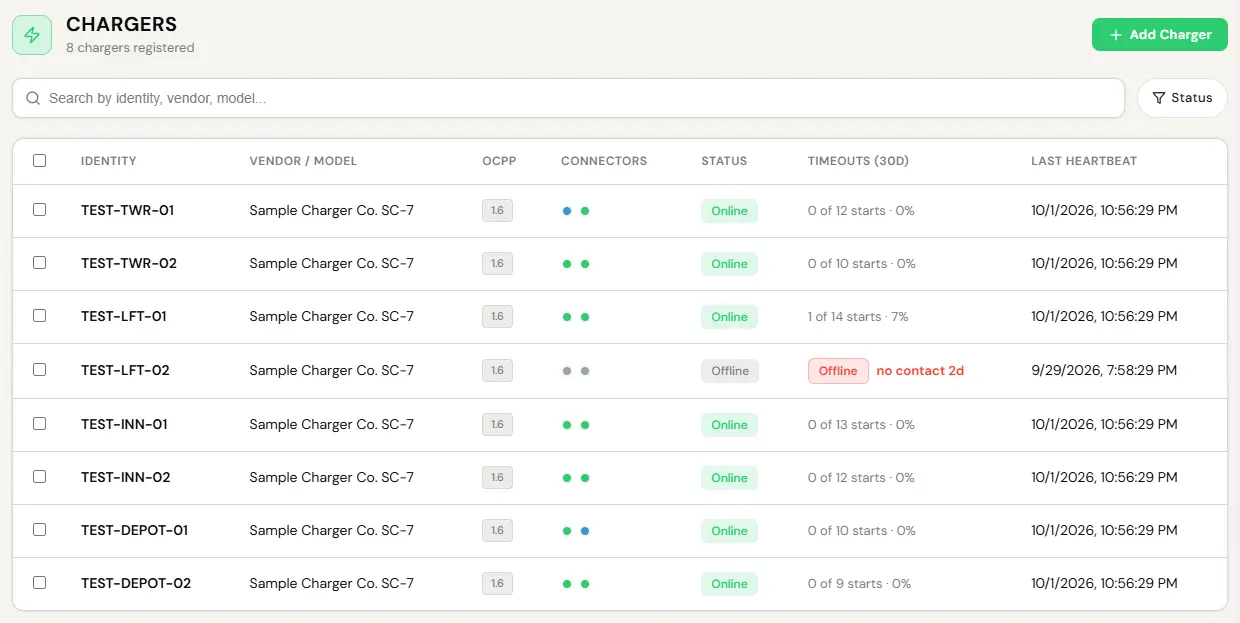
- The identity is never typed twice. A mismatch is silent and permanent until corrected.
- Free chargers are first class. Access control, scheduling, load management, reporting and diagnostics all work identically, and in Canada a free session still generates carbon credits.
- Status is per connector. A dual-port unit can be busy on one side and free on the other.
- Suspended usually is not a fault. It is a full battery or a car on its own schedule.
- A stranded session closes itself and bills the last reading we received. You do not have to find it.
- Resident-owned chargers in your building are not billed to you and are free to their owner. You still run the site.
- Your data is exportable, all of it. A platform you cannot leave is one you should not have joined.
Getting a human
Most of what an operator needs is on these pages or answerable by asking EVII™. When it genuinely is us, these are the ones to send:
- A charger showing online that has not sent a message in hours.
- A billed amount that does not match the energy on the session record.
- A late payout with Stripe onboarding complete and no error showing.
- A load limit that will not clear after demand dropped.
- Anything in the console that disagrees with itself.
support@evinitiative.com, with the charger identity and roughly when it happened. That is enough for us to find it in the message history.
That is a bug in the manual, not in you. Tell us what you were trying to do and we will add the page, because the alternative is answering it one person at a time forever.