
Run the site
Power
and load.
Why twenty cars at 6pm does not trip your service, what a cap is, and the one failure mode worth knowing about.
The problem it solves
Twenty vehicles plugged in at six in the evening is more current than most buildings can supply. There are three ways that ends: somebody staggers it by hand forever, a breaker trips, or the site pays for an electrical upgrade it did not actually need.
Load management is the fourth. The platform shares what capacity exists across the chargers on a circuit, and lifts the limit again as demand falls. Nobody staggers anything and nothing trips.
A car set to draw its maximum took only the cap the platform pushed. That is the whole promise: the limit is real at the hardware, not a suggestion in software.
Circuits
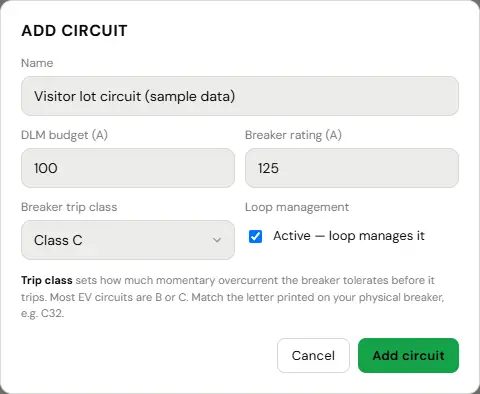
A circuit is a group of chargers that share an electrical supply. You tell the platform what that group is and what it can carry, and the sharing happens inside it.
- Open the location, then circuits.
- Create a circuit and set its capacity.
- Add the chargers that share that supply.
Get the capacity from your electrician or the panel schedule. It is the one number here you should not guess at.

Caps, and releasing them
When demand exceeds what the circuit can carry, the platform pushes a per-charger limit. When demand falls, it lifts it.
The interesting part is the second half. A limit that was applied has to be released, and a system that forgets is worse than one that never capped anything, because the site quietly delivers half the power it should and nobody knows why. So the obligation to release is recorded before anything is applied, a sweep retries every five minutes, and any cap still in force shows on the charger’s own page where you can see it.
- Open the charger page.
- Look for an Amperage cap card on the Overview tab.
- If demand has dropped and it is still there, use Clear Charging Profile on the Commands tab.

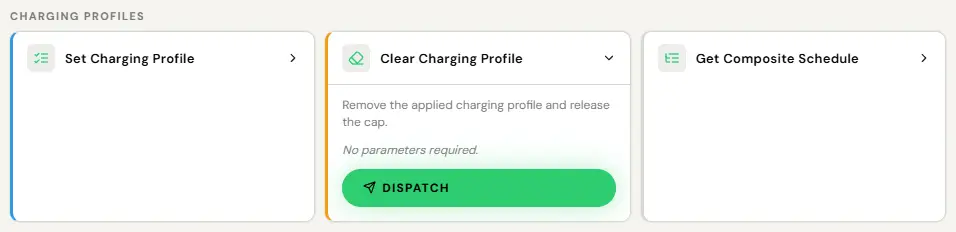
You can also set a cap deliberately on one charger, from the same place, without touching the panel. That is useful for a unit on a shared supply with something else, or a bay you want to slow down for a reason of your own.
What it costs
$4 per managed charger per month, or $40 a year, and only on the chargers that need it. If your service runs everything at full power at once, you do not need it and should not pay for it.
The comparison worth doing is not against nothing. It is against the electrical upgrade you would otherwise be quoted, which is usually a five figure number and several months.