Pricing
$8 a charger.
You keep 85%.
No term.
Every figure we charge, on one page, with what we do not charge underneath it. No sales call needed to find out.
In one paragraph
A homeowner who owns their charger and their property pays nothing and keeps 85% of every kWh a guest buys. A resident who owns a plug in a building earns the margin they set above the building’s electricity cost. A building, hotel or workplace pays $8 per charger per month and keeps 85% of net. A fleet pays $20 a month per account plus $18 per charger. Load management is $4 per managed charger where the electrical service needs it. Every annual is ten months, so two are free. Hosts pay no per-session fee, no setup fee, no minimum and no contract term, and every rebate, grant and tax credit stays with the owner.
- $8
Per charger per month. $80 a year. Buildings and commercial sites.
- Free
Homeowners and residents who own their charger. No subscription, ever.
- 85 / 15
The host keeps 85% of session revenue. EV Initiative keeps 15%.
- 10 months
What a year costs. Two are free on every annual plan.
Platform
Per charger.
Per month.
One number for a building, a hotel, a dealership, a retail lot or a workplace. Nothing for a homeowner or a resident who owns their plug.
| Product | Billed per | Monthly | Annual |
|---|---|---|---|
| Platform | Charger | $8 | $80 |
| Load management | Managed charger | $4 | $40 |
| Residential host | Charger | Free | Free |
Resident-owned chargers in a building are free to their owner and are never billed to the building. They earn the resident the margin they set above the building’s electricity cost.
Per charger, per month. $80 a year.
Keep 85% of net. No term. Rebates stay yours.
Buildings →No subscription. No fee. Ever.
Keep 85% of every kWh a guest buys. Your charging stays free.
Home →Points of our 15-point platform share, on every paid session at a pay-to-use charger you originate and deploy. Standard commission starts at your fourth qualifying charger.
Standard is free to join. Golden Partners can reach 5 points. Hardware at MSRP.
Installers →Base, plus per charger, monthly.
Drivers never see a bill. No per-session fee.
Fleets →Fleet
A base, and
what you own.
A fleet driver charging at somebody else’s public charger costs the fleet nothing in subscription. The fleet pays for the energy at that charger’s price, visible before the driver starts.
| Monthly | Annual | |
|---|---|---|
| Fleet base, per account | $20 | $200 |
| Per charger the fleet owns | $18 | $180 |
| Load management, per managed charger | $4 | $40 |
| RFID keyfob, fleet rate | $15 each | One time |
A consumer pays $50 for a new RFID card and $25 to register one they already own. A fleet pays $15 per keyfob and pays it themselves rather than passing it to the driver.
The split
Eighty-five, fifteen.
Then one detail.
The host keeps 85% and EV Initiative keeps 15%. What the 85% is a percentage of differs by model, and there is a reason that holds up in a contract.
85% of every kWh sold.
Before card processing, before anything. The published Host Program Terms say a host receives 85% of every kWh a guest buys, and what guests pay is gross. EV Initiative absorbs the card processing fee out of its own 15%.
On a small session that can cost us money. A two dollar charge produces a thirty cent platform share, and card processing on a charge that small can cost more than that. It reverses at scale, and a platform paying less than it promised is a worse problem than a thin margin on small sessions.
85% of net.
After card processing and after any electricity reimbursement recorded for the site, under our Site Host Terms.
A commercial site is a different agreement. The volumes are larger, the sessions are larger, and the electricity is typically metered and reimbursed separately. The homeowner’s gross basis exists because a residential session is small enough that a fixed card fee would swallow it.
It would be simpler to have one rule. It would also be wrong. The boundary is enforced rather than assumed: a commercial host cannot land on the residential basis and a resident cannot land on the commercial one, because the two are gated on different fields and the gate is checked on every settlement.
What is not charged
The list that
matters most.
Session fees shown upfront
Connection and idle fees, where set, are shown before charging.
No percentage beyond the 15%
One share, stated once.
Nothing for drivers or the app
Or the console, or support, or adding a site.
Nothing for an idle charger
A charger nobody used this month costs the same as one nobody installed.
No setup fee, no minimum
And no contract term.
No cut of your hardware margin
Installers buy at MSRP and price their own work.
No cut of rebates or grants
Every incentive, rebate, grant and tax credit stays with the owner.
No cost to leave
Stop paying, keep your hardware, take your data.
Hardware
At MSRP.
Published.
Autel, programmed to the network before it ships, drop-shipped to your site. Installers pay the same and keep their margin.
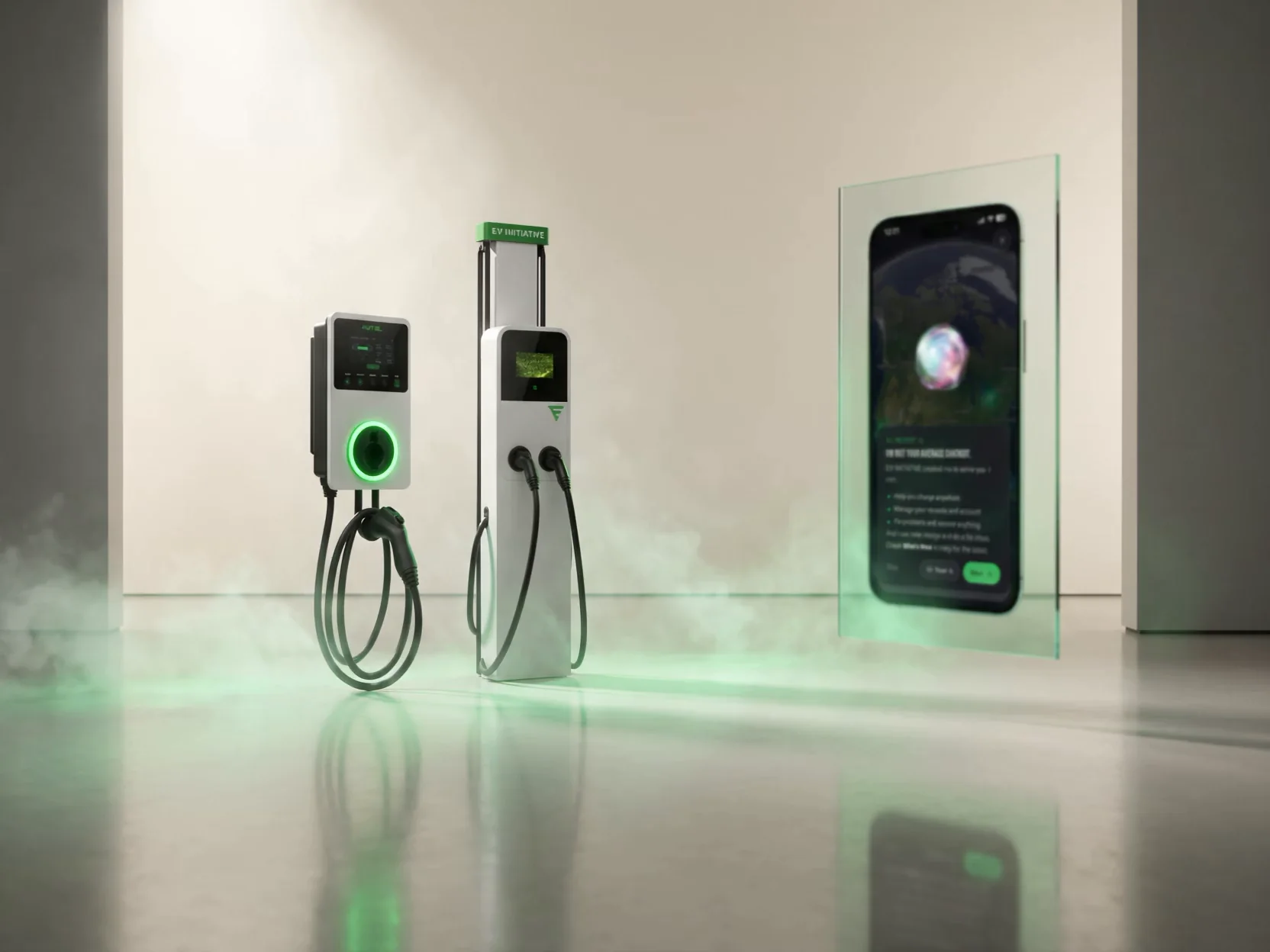
Home wallbox and pedestal sets on the shop. Prices in USD, shipping and tax at checkout. The platform is hardware-agnostic across OCPP, so you are not required to buy from us at all.
Pricing
No setup fee.
Clear session pricing.
No term.
Every figure is already on this page. Tell us how many chargers and what kind of site and we will put a number against yours.
Questions
Straight
answers.
See what the platform does for your chargers.
Explore operations (opens in a new tab)What does EV Initiative cost?
It depends on who owns the charger. A homeowner who owns their charger and their property pays nothing and keeps 85% of every kWh a guest buys. A resident who owns a plug in a building earns the margin they set above the building’s electricity cost. A building, hotel, dealership, retail site or workplace pays $8 per charger per month, or $80 a year, and keeps 85% of net. A fleet pays $20 per account per month plus $18 per charger per month. Load management is $4 per managed charger per month wherever it is used.
What does "annual is ten months" mean?
Paying for a year costs ten months. Two are free. $8 monthly becomes $80 a year, $18 becomes $180, $4 becomes $40, and the $20 fleet base becomes $200.
What is the revenue split?
The host keeps 85% and EV Initiative keeps 15%. A residential host keeps 85% of every kWh sold, before card processing, because the Host Program Terms say a host receives 85% of every kWh a guest buys. A commercial site keeps 85% of net, after card processing and any electricity reimbursement recorded for the site. Electricity reimbursement follows the Site Host Terms, which give a site 60 days from launch to connect its bank account.
What is not charged?
No additional platform percentage beyond the 15%. Connection and idle fees, where set, are shown before charging. No charge for drivers, for the app, for the console, for support, for adding a site, or for a charger that sits unused. No setup fee and no minimum.
Is there a contract term?
No. Stop paying, keep your hardware, take your data.
What does an RFID card cost?
$50 for a new consumer card and $25 to register one you already own. A fleet operator pays $15 per keyfob, and pays it themselves rather than passing it to the driver.
Does an installer commission cost me anything?
No. If a Sales Partner brought your site to us and deployed your chargers, they earn 2 to 3 points of EV Initiative’s 15-point platform share on every paid session at a pay-to-use charger, calculated on the same basis as our share. It never comes out of your 85%. You pay exactly the same either way. A Golden Partner can earn up to 5 points on qualifying chargers deployed after enrolment, from the same 15. A home charger, or a site EV Initiative sourced, carries no partner commission.
What does the hardware cost?
Autel units at MSRP, published on evinitiative.shop. An AC Ultra single port is $3,130 and a dual port is $5,510, both wall mounted with a 25 foot cable. A DC Compact 40 kW starts at $19,075, wall or pedestal, programmed to the network before it ships. Installers pay the same and keep their own margin.
Do you take a cut of rebates or grants?
No. Every incentive, rebate, grant and tax credit stays with the owner. That is in the contract rather than a policy that can change.
Get a number for your site.
Tell us how many chargers and what kind of site. A person replies within one business day.