
EVSE Energy Management System (EMS) Integration Plan
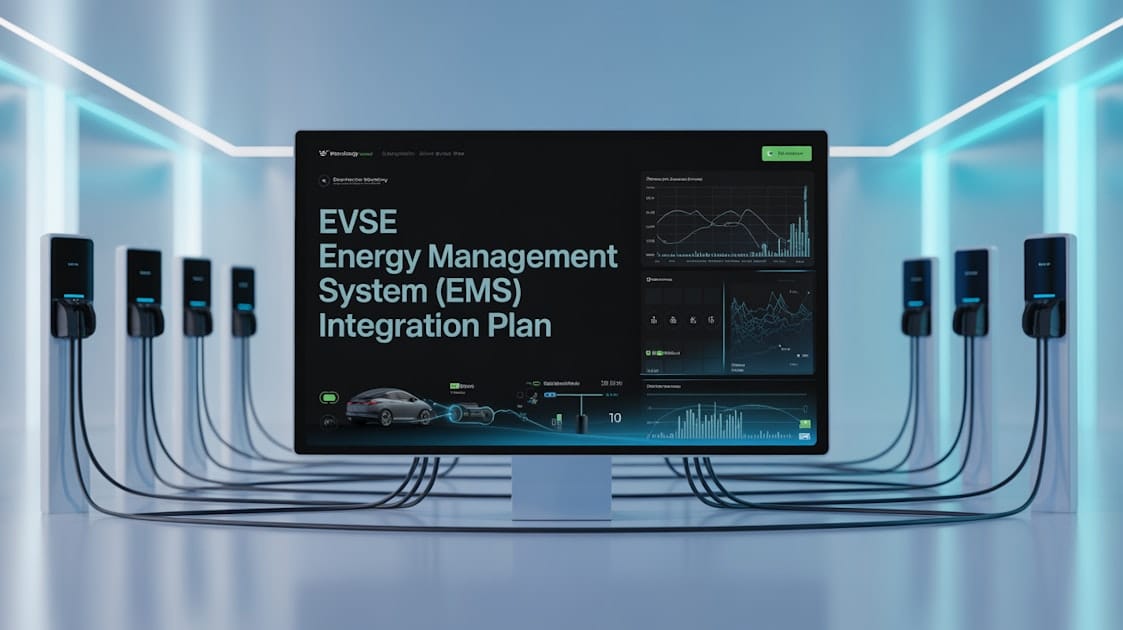
Project Goal: Comply with NEC 625.42(A) and maximize power allocation across 20 DC fast charging stalls without oversizing the 4000A electrical service.
🔷 Objective
To avoid the 125% continuous load penalty under NEC 625.42, we are integrating a real-time Energy Management System (EMS) that allows the overall connected EVSE load to exceed 4,000A without exceeding the available service at any time.
This system will:
- Monitor actual site current draw in real-time
- Dynamically adjust charger power output based on available headroom
- Comply with NEC 625.42(A) using UL-listed hardware
- Interface directly with our backend Charging Management System (CMS), which operates over OCPP 1.6J and 2.0.1
🔷Load Management Approach
- Total charger capacity: ~3,940A @ 480V 3Φ
- Static de-rating would limit usable output to about 150 kW per charger unless we: Install an EMS that is properly integrated, or
- Oversize the service to 5000A+
With an EMS, we dynamically distribute load only when multiple vehicles are charging simultaneously, avoiding the need to permanently limit charger output.
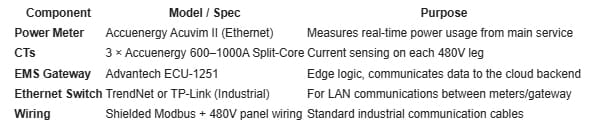
🔷Hardware Stack (Proposed EMS)
All hardware will be UL/CSA rated and support Modbus TCP/RTU for industrial interoperability.
🔷CMS + OCPP-Based Control
Our Charging Management System (CMS) — admin.evinitiative.com — is a custom-built platform that communicates with all chargers via OCPP 1.6J or 2.0.1.
- The EMS gateway will push real-time power usage (amps, kW) to the CMS via HTTP or MQTT.
- The CMS dynamically issues
SetChargingProfilecommands via OCPP to each EVSE, reducing or restoring power allocation depending on the site’s available capacity. - This means chargers can operate at full power when headroom exists, and safely throttle only when site load peaks.
🔷NEC 625.42(A) Compliance
This architecture qualifies under NEC 625.42(A), which permits limiting the overall rating of the installation through an Energy Management System (EMS) if it:
- Conforms to NEC 750.30
- Integrates listed hardware and software
- Clearly marks the installation for load-managed operation
Our system meets all those conditions.
🔷 Result
With this EMS in place, we will fully utilize the 4000A service without exceeding it, and stay within code. This means our OCPP CMS can throttle the cabinets based on EMS data, and the cabinets will intelligently distribute available power among connected dispensers. If one car is charging, it can receive full power (up to 500 kW); if five are charging, each receives a fair share, depending on cabinet capacity.

EVI Infrastructure Inc is not a broker-dealer, funding portal, or investment adviser. All investment opportunities will be offered exclusively through a SEC-registered funding portal or broker-dealer. This website collects expressions of interest only.